 Mary Kate Ryser-Oatman
Journal #10
Maria Amparo Ruiz de Burton, "The Squatter and the Don"
February 6, 2009
"This county is...a good grazing county-one of the best counties for cattle-raising on this coast, and the very best for fruit-raising...Why, then, not devote your time, your labor, and your money to raising vineyards, fruits, and cattle, instead of trusting to the uncertain rains to give you grain crops?" (Ruiz de Burton 96).
Don Mariano is giving the farmers who grow crops around his property a proposition that involves either raising their own herds or growing fruits, since he is tired of them killing his cattle because they get into their grain crops.
I thought that Don Mariano made a good proposition to the farmers. He realized that the "No-Fence Law" was an issue because it entitled farmers to have their grains on open, unfenced land, but since San Diego County was dependent on cattle grazing; he did not have to fence in his cattle. I also think that he just chose not to fence them in. He makes good money from selling the cattle, and they need to be able to roam freely. His main issue was the farmers shooting his cattle whenever they were caught eating their grain crops. He feels that he should not have to fence his cattle in because they are important to their county, and that the farmers should have to fence their grain crops in to protect them from the cattle. Don Mariano realized that most of the farmers will not comply to this because they feel they should not have to, and because fencing their land is expensive. Thus, he felt that by giving the farmers different ideas on how to use their land, the farmers would realize that Don Mariano's cattle are important and make a good profit, as well as growing fruits or having vineyards.
Some of the farmers resent Don Mariano, and are not open to his ideas. They still stand by their actions in killing his cattle they catch in their grain crops, because he should have them fenced in. I thought they should have listened to Don Mariano. He provided a lot of support for his arguments, and he seemed to be an expert on what he was talking about. It is true that he was trying to turn things in his favor, but I think he was really trying to help the farmers and give them advice so they could succeed. He was thinking about their entire county and how they could better what they produced. Don Mariano also made a good point, that they would make a bigger profit on fewer acres of vineyards and orchards than they would on a larger plot of land with grain crops. The unpredictable rain fall is also something that puts them at a disadvantage for their grain crops, where maintaining cattle, orchards and vineyards are easier.
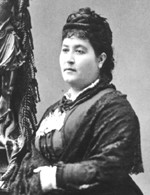
Maria Amparo Ruiz de Burton lived on her ranch after her husband's death, and became a farmer herself. According to Wikipedia, a variety of produce came from her ranch, "In the early 1870s, she continued living on Rancho Jamul where she ran cattle, grew wheat, barley, and castor beans, and rented the wildflowered hillsides to beekeepers." Ruiz de Burton seemed to emphasize the importance of different possibilities in her own life, as she produced many different sources of income on her ranch. She is supporting Don Mariano's point that while grain crops were needed in their society, there were other types of crops and produce they could grow to better their lives financially and their community with produce.

20 points. It would be so fun to find the location of "Rancho Jamul" on a contemporary map of San Diego!
ReplyDelete